> For the complete documentation index, see [llms.txt](https://docs.booms.live/llms.txt). Markdown versions of documentation pages are available by appending `.md` to page URLs; this page is available as [Markdown](https://docs.booms.live/zegocloud-setup.md).
# Zegocloud Setup
Quickly obtain real-time audio and video communication capabilities and enjoy smooth, reliable audio and video experiences with high quality even in weak network condition.
Dative uses Zegocloud for Live streaming feature, zegocloud is cheaper and better several WebRTC providers. I'ts free to begin and you pay only when you grown check [Zegocloud Pricing.](https://www.zegocloud.com/pricing/product-list#live-streaming)
### Step 1: Create a ZEGOCLOUD Account
1. Go to the [ZEGOCLOUD website](https://www.zegocloud.com/).
2. Click on the **Sign Up** button located in the top right corner.
3. Fill in the registration form with your email, password, and other required information.
4. Click **Sign Up** to create your account.
5. Verify your email address by clicking on the verification link sent to your email.
6. Log in to your ZEGOCLOUD account with your credentials.
### Step 2: Create a New App in ZEGOCLOUD
1. After logging in, you will be directed to the ZEGOCLOUD dashboard.
2. Click on **Create a New Project** or **Add App**.
3. Enter the **App Name** for your new project.
4. Choose the **Industry** your app belongs to (e.g., Entertainment).
5. Select the **Scenario** that best describes your app (e.g., Live Streaming).
6. Click **Create** to generate your new app.
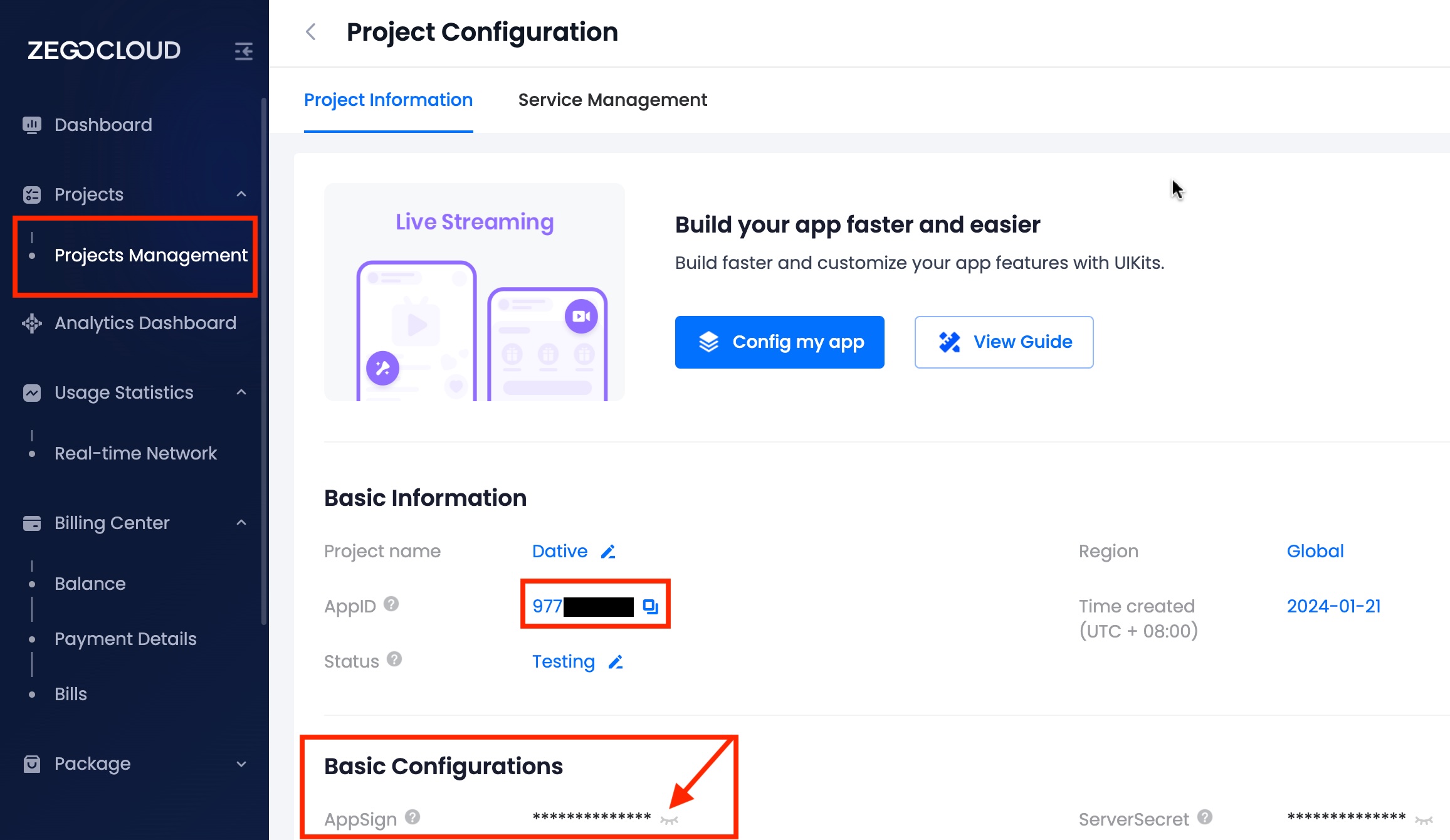
### Step 3: Get the App ID and App Sign
1. Once the app is created, you will be redirected to the app's dashboard.
2. The **App ID** and **App Sign** will be displayed on the dashboard. Note these down as you will need them for integrating live streaming into your application.
Zegocloud App Dashboard
**Make sure that at the end of this progress, you have saved for later use:**
* `App ID ID`
* `App Sign`